
In the field of energy transmission, high-pressure long-distance oil and gas pipelines often need to traverse Gobi deserts, arid desert regions, swamps, and a wide range of complex soil conditions. Throughout their service life, these pipelines are continuously exposed to the dual challenges of external soil electrochemical corrosion and internal erosion from transported media.
How can pipeline integrity and leak-free performance be ensured over a service life spanning several decades? Anti-corrosion spiral steel pipes play an irreplaceable and critical role in this regard.
This article provides an in-depth analysis of the specific application scenarios and key technical requirements of anti-corrosion spiral steel pipes in oil and gas projects, and further explores how selecting a qualified anti-corrosion spiral steel pipe manufacturer can effectively ensure overall project safety and reliability.
I. Why Are “Spiral Steel Pipes” Preferred as the Base Pipe for Oil & Gas Pipelines?
In oil and gas transmission projects, the mechanical performance of the base pipe (the bare steel pipe before any anti-corrosion coating) forms the foundation of pressure-bearing capacity. Compared with Longitudinal Submerged Arc Welded (LSAW) pipes and Electric Resistance Welded (ERW) pipes, Spiral Submerged Arc Welded (SSAW) pipes offer distinct advantages in long-distance oil and gas pipeline networks:
Burst Resistance Performance
The weld seam of spiral steel pipes is distributed in a helical (spiral) pattern. When the pipeline is subjected to high internal pressure from oil or gas, the combined stress acting on the weld seam is significantly lower than that of a longitudinal seam pipe. This means that, under the same wall thickness, spiral steel pipes are capable of withstanding higher operating pressures, offering superior safety performance in high-pressure transmission systems.
Large Diameter with High Cost Efficiency
Long-distance oil and gas pipelines are typically designed with large diameters (e.g., DN800–DN1420 and even larger) to improve transmission efficiency. Spiral steel pipes can be manufactured from steel coils of the same width into pipes of varying diameters. This flexible forming process provides extremely high production efficiency and significant cost advantages, particularly in large-diameter pipeline manufacturing.
Dimensional Accuracy and Crack Arrest Performance
Modern SSAW pipes offer excellent geometric dimensional tolerances. In addition, the spiral weld structure provides a natural “crack-arresting” effect under accidental impact or geological deformation, effectively preventing cracks from propagating in a straight line and significantly improving the overall structural safety of the pipeline system.
II. Core Anti-Corrosion Coating Systems in Oil & Gas Projects
Once buried underground, bare steel pipelines are rapidly subject to corrosion perforation caused by soil moisture, salinity, and stray current interference. Therefore, in oil and gas pipeline projects, it is essential to apply high-performance external anti-corrosion coating systems on spiral steel pipes. Among global oil and gas standards, the most widely adopted and industry-proven solution is the 3PE anti-corrosion coating system.
1. The Three-Layer Protection System of 3PE Coating
The 3PE (Three-Layer Polyethylene) anti-corrosion system combines the strong adhesion of fusion-bonded epoxy with the excellent mechanical strength and weather resistance of polyethylene, forming a highly durable protective barrier:
? Bottom Layer: Fusion Bonded Epoxy (FBE, ≥100 μm)
Applied directly onto the spiral steel pipe surface after shot blasting and rust removal, the FBE layer provides excellent chemical stability, strong adhesion to steel, and outstanding resistance to cathodic disbondment. It serves as the fundamental anti-corrosion barrier at the steel interface.
? Middle Layer: Adhesive Layer (AD, 170–250 μm)
This functional bonding layer acts as a transition medium. It chemically reacts with the epoxy bottom layer while simultaneously co-extruding and bonding with the outer polyethylene layer. As a result, the three layers are tightly integrated into a single, inseparable protective system.
? Outer Layer: High-Density Polyethylene (HDPE, 2.5–3.7 mm)
The outer layer provides robust mechanical protection. It is highly resistant to abrasion, impact, and mechanical damage during transportation, lifting, and backfilling operations. In addition, it effectively isolates the pipeline from soil moisture and plant root penetration, ensuring long-term service stability in harsh buried environments.
2. Internal Coating: Drag-Reduction and Flow Optimization Layer
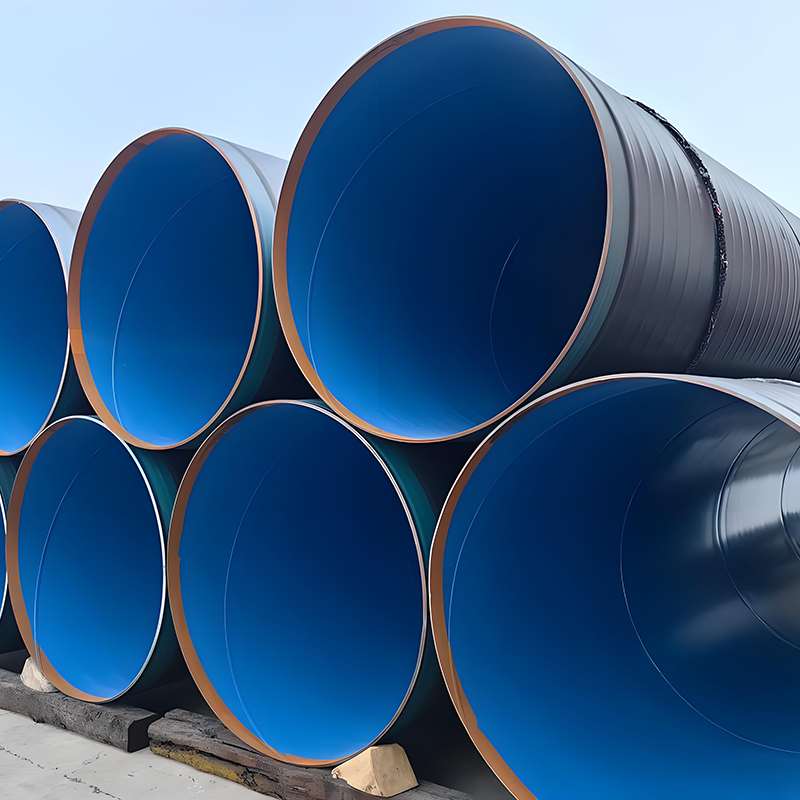
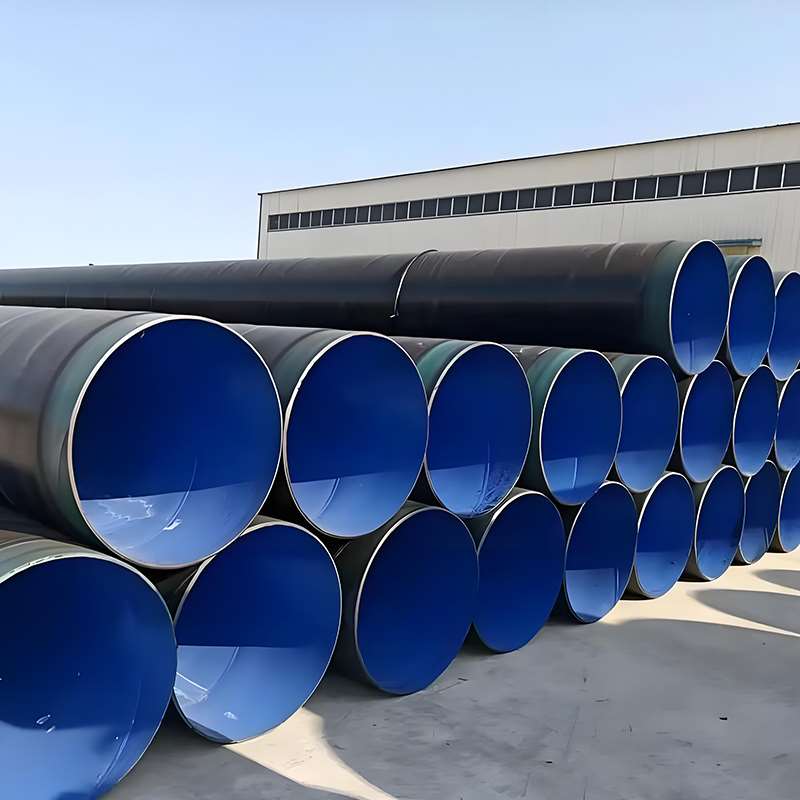
In addition to external corrosion protection, the internal surface of long-distance natural gas pipelines is typically coated with a thin layer of epoxy-based flow efficiency (drag-reduction) coating, with a thickness of approximately 20–30 μm.
Its primary function is not corrosion protection, but to reduce the internal surface roughness of the pipeline.
A smoother internal wall significantly decreases frictional resistance during gas transmission, thereby improving flow efficiency. Natural gas transport capacity can be increased by approximately 5%–8%, while simultaneously reducing the energy consumption of compressor stations along the pipeline. This results in substantial savings in electricity and fuel costs for pipeline operators over long-term operation.
III. Strict Requirements for Anti-Corrosion Spiral Steel Pipe Manufacturers in Oil & Gas Projects
Oil and gas are highly flammable, high-pressure media. Any pipeline perforation caused by coating failure can trigger catastrophic fire accidents or severe environmental disasters. As a result, oil and gas projects impose extremely stringent qualification and process requirements on manufacturers of anti-corrosion spiral steel pipes during the bidding and evaluation process.
1. Surface Preparation Must Reach Sa2.5 / Sa3.0 Standards
The adhesion performance of the anti-corrosion coating is fundamentally determined by surface preparation quality. Qualified manufacturers must be equipped with high-power external pipe shot blasting systems capable of thoroughly removing mill scale and surface oxides formed during hot rolling.
After blasting, the steel surface must achieve a uniform metallic brightness and a controlled micro-roughness profile (anchor profile depth). This engineered surface texture is critical to ensure strong mechanical interlocking and adhesion of the fusion-bonded epoxy (FBE) layer.
2. Precise Medium-Frequency Induction Heating and Temperature Control
The 3PE coating process relies on a combination of thermal spraying and extrusion wrapping technologies. During application, steel pipes must be heated in a medium-frequency induction furnace to a controlled temperature range of 200°C to 220°C.
- If the temperature is too low, the epoxy powder will not fully cure, leading to potential coating delamination during service.
- If the temperature is too high, the epoxy resin may degrade and age prematurely, resulting in a significant and irreversible reduction in anti-corrosion performance.
Therefore, manufacturers must be equipped with fully automated inline infrared temperature monitoring and feedback control systems to ensure uniform heating across every meter of each pipe.
3. Strict Quality Inspection and Testing Procedures
Before leaving the factory, anti-corrosion spiral steel pipes must pass three critical quality assurance tests:
? Holiday (Spark) Detection Test
A 25 kV high-voltage holiday detector is used to perform 100% full-surface inspection of the coating to ensure there are no microscopic pinholes or coating defects that are invisible to the naked eye.
? Coating Adhesion (Peel Strength) Test
Peel strength tests are conducted at both 20°C and 60°C to verify coating adhesion performance. The measured peel force per 100 mm must fully comply with relevant national and international standards, such as GB/T 23257 or API 5L requirements.
? Cathodic Disbondment Test
Laboratory simulation tests lasting 28 days or longer are performed to evaluate coating stability under cathodic protection conditions. The purpose is to ensure that the coating does not experience edge lifting or delamination due to electrochemical reactions during long-term service.